Measuring B2B SMS campaign ROI requires tracking different metrics than email or paid ads. This guide covers the specific metrics that tie your B2B SMS outreach directly to pipeline, demos booked, and closed revenue — not just open rates.
Every sales and marketing leader eventually faces the same question from the C-suite: “What’s the ROI on this?” For B2B SMS outreach, the answer should be easy — SMS is one of the most measurable channels available. But too many teams track the wrong metrics, celebrate vanity numbers, and miss the data that actually ties outreach activity to revenue.
This guide covers exactly which metrics matter in a B2B SMS campaign, how to calculate real ROI, and how to use that data to optimize future campaigns.
The Metrics That Matter (And the Ones That Don’t)
Delivery Rate — The Baseline
Delivery rate is the percentage of messages successfully delivered to recipients. This is your floor metric. If delivery is below 90%, there’s a platform or compliance issue to resolve before worrying about anything else.
Target: 95%+ delivery rate. Anything below 90% indicates number quality or carrier filtering problems.
B2BSMSMail’s carrier-optimized infrastructure and number rotation system is specifically designed to maintain high delivery rates across large-volume campaigns.
Click-Through Rate (CTR) — Intent Signal
CTR measures the percentage of delivered messages where the recipient clicked your URL. This is your first real signal of intent — someone who clicks is engaging with your offer, not just reading the message.
B2B SMS benchmark: 19–36% CTR on well-targeted campaigns (vs. 2–5% for email)
Formula: (Total Clicks ÷ Total Delivered Messages) × 100
Low CTR usually indicates a copy problem — either the value proposition isn’t compelling, the CTA isn’t clear, or the message isn’t relevant enough to the target audience. A/B test your message to isolate the issue.
Response Rate — Engagement Depth
Response rate measures the percentage of recipients who replied to your SMS. In B2B, replies are gold — they signal strong intent and open a direct conversation with a decision-maker.
B2B SMS benchmark: 20–45% response rate on highly targeted, well-written campaigns
Formula: (Total Replies ÷ Total Delivered Messages) × 100
A low response rate with a high CTR tells you the landing page or offer isn’t converting interested clickers into active conversations. Check your landing page.
Cost Per Engaged Lead (CPEL) — The Key ROI Metric
This is the metric most teams overlook — and it’s the most important for calculating real campaign ROI. An “engaged lead” is defined as a contact who either clicked your link, replied to your SMS, or took a defined action on your landing page.
Formula: Total Campaign Cost ÷ Number of Engaged Leads = CPEL
Example calculation using B2BSMSMail pricing:
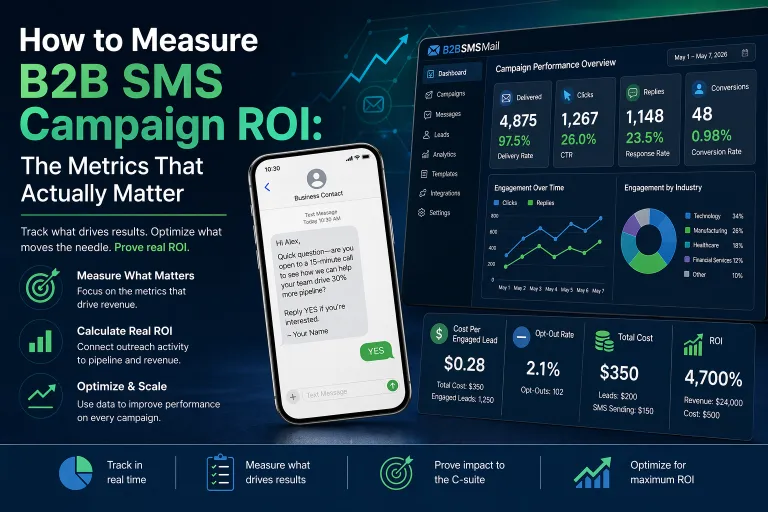
- Campaign: 5,000 AI-generated leads × $0.04 = $200
- SMS sending: 5,000 messages × $0.03 = $150
- Total cost: $350
- Responses at 25% rate: 1,250 engaged leads
- CPEL: $350 ÷ 1,250 = $0.28 per engaged lead
Compare that to paid search CPCs of $5–$50 per click in competitive B2B verticals. The efficiency advantage of SMS is enormous.
Opt-Out Rate — The Health Check
Opt-out rate measures the percentage of recipients who reply STOP or otherwise unsubscribe from your campaigns. A healthy opt-out rate signals that your targeting and messaging are relevant. A high opt-out rate signals the opposite.
Acceptable range: 1–5% for B2B SMS (higher than email due to the personal nature of SMS)
Consistently high opt-out rates (above 5%) indicate one of three problems: wrong audience targeting, overly aggressive messaging, or excessive send frequency.
Conversion Rate — The Bottom Line
Conversion rate ties your SMS campaign directly to business outcomes: demo requests, form completions, trial sign-ups, or booked calls. This is the metric that translates marketing activity into revenue pipeline.
Formula: (Total Conversions ÷ Total Delivered Messages) × 100
Define what a “conversion” means for your campaign before launch. Without a clear definition, you can’t measure it — and you can’t optimize toward it.
How to Calculate Full Campaign ROI
Once you have conversion data, calculating ROI is straightforward:
ROI = ((Revenue Attributed to Campaign − Campaign Cost) ÷ Campaign Cost) × 100
Example:
- Campaign cost: $500 (leads + SMS sending)
- Conversions: 12 demo requests → 3 closed deals
- Average deal value: $8,000
- Revenue attributed: $24,000
ROI: ((24,000 − 500) ÷ 500) × 100 = 4,700% ROI
Even in a more conservative scenario with 1 closed deal from 5,000 messages, at an average deal value of $5,000 on a $350 campaign spend, the ROI remains exceptional.
Reporting Cadence: What to Review and When
Real-Time (During Campaign)
- Delivery rate — flag immediately if below 90%
- Reply volume — monitor for spikes indicating a highly resonant message
- Opt-outs — halt campaign if opt-outs exceed 7–8%
48 Hours Post-Launch
- CTR and response rate — determine if A/B winner is clear
- Engagement by industry segment — identify which verticals respond best
- Cost per engaged lead — compare to benchmark and previous campaigns
End of Campaign
- Conversion rate and total conversions
- Pipeline value generated
- Full ROI calculation
- Top-performing message variant for future use
Using Analytics to Optimize Future Campaigns
The data from one campaign is the strategy for the next. Here’s how to turn analytics into improvements:
- High delivery, low CTR: Copy problem. Rewrite the value proposition with a more specific outcome.
- High CTR, low conversion: Landing page problem. Make the CTA clearer or reduce friction.
- High response rate from one industry: Double down on that vertical in the next campaign.
- High opt-out rate: Targeting problem. Narrow your audience or refine your role selection.
Where to Track All of This
B2BSMSMail’s built-in analytics dashboard tracks delivery rate, CTR, reply rates, and credit usage in real time — organized by campaign, industry segment, and message version. This means you don’t need a separate analytics tool for SMS performance tracking. See how the dashboard works on the B2BSMSMail homepage or review what’s included in each plan on the pricing page.
Questions about how analytics work in your specific use case? Contact the team for a walkthrough, or sign up and explore the dashboard yourself.