This guide settles the B2B SMS vs cold calling debate with data from 2026 — comparing reply rates, cost per meeting booked, and which outreach method wins across different B2B sales scenarios.
Cold calling has been the backbone of B2B outreach for decades. But in 2026, something has shifted. Executives screen calls from unknown numbers. Voicemails go unchecked for days — or forever. Gatekeepers are trained to filter unsolicited sales calls before they ever reach a decision-maker.
At the same time, B2B SMS outreach is growing rapidly, with open rates above 98% and response rates that leave cold calling in the dust. But does that mean the phone is dead? And should your team be texting instead of dialing?
Let’s break it down across the metrics that matter most to B2B sales leaders.
The Numbers: A Side-by-Side Comparison
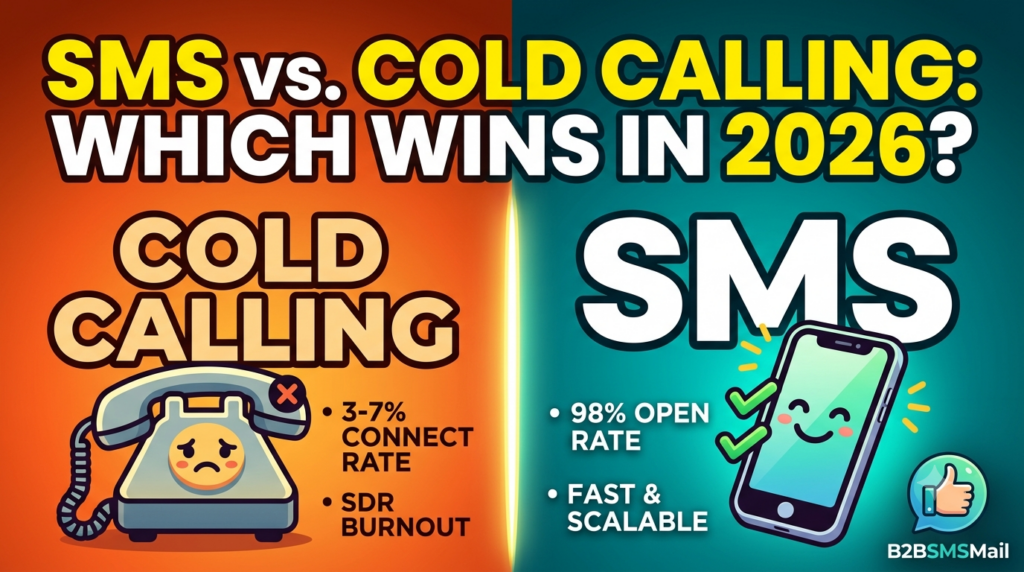
- Cold call connect rate: 2–8% (percentage of calls that reach a live decision-maker)
- SMS open rate: 98% — virtually every message is read
- Cold call callback rate: less than 1% of voicemails result in a callback
- SMS response rate: 20–45% for targeted B2B campaigns
- Time to first engagement: Cold calling requires multiple attempts over days or weeks. SMS averages first engagement within 3 minutes of delivery.
- Scalability: A rep can make 50–80 cold calls per day. A single SMS campaign can reach thousands of decision-makers simultaneously.
- Cost per contact: Cold calling requires sales headcount. B2B SMS with B2BSMSMail costs 3¢ per message + 4¢ per AI-generated lead.
Where Cold Calling Still Has a Role
Cold calling isn’t dead — it’s evolving. There are specific scenarios where a phone call remains the better tool:
High-Value, Complex Deals
For enterprise deals with long sales cycles and multiple stakeholders, voice communication builds the kind of trust that text messages simply cannot. If you’re selling a seven-figure contract to a Fortune 500 procurement committee, cold calling (and eventually, relationship-driven account management) is still essential.
Warm Follow-Up After SMS Engagement
One of the most effective sequences in modern B2B sales is SMS first, phone call second. When a decision-maker responds to an SMS with interest, following up with a call is no longer “cold” — they’ve already expressed intent. The phone call converts dramatically better when it’s warmed by prior SMS engagement.
Highly Regulated Industries
In some industries — financial services, healthcare, government procurement — initial outreach via voice with documented consent protocols is preferred or required for compliance. In these cases, cold calling to establish contact and obtain permission for follow-up may precede SMS outreach.
Where SMS Decisively Outperforms Cold Calling
Volume and Scale
A sales rep making 60 cold calls a day might reach 3–5 live decision-makers. A B2B SMS campaign targeting the same audience can reach 5,000 decision-makers in the same day — and generate responses within minutes.
The scale advantage of SMS is not marginal. It’s an order of magnitude difference in reach per dollar and per hour of effort.
First Contact with Unknown Decision-Makers
Getting through to a CFO or COO via cold call is increasingly difficult. Their numbers are often unlisted, calls from unknown numbers are screened, and voicemails are rarely returned. SMS sidesteps the gatekeeper entirely — it lands directly in the decision-maker’s pocket and gets read.
Measurability
Cold calling produces highly variable, hard-to-measure outcomes. SMS campaigns produce clear, real-time data: delivery rate, click rate, response rate, and cost per engaged lead. This makes it far easier to optimize B2B SMS campaigns over time.
Cost Efficiency for Prospecting
Cold calling at scale requires a dedicated SDR team — a significant ongoing overhead. B2B SMS outreach can prospect at massive scale for a fraction of the cost, freeing your sales reps to focus on qualified conversations rather than dial-and-hope prospecting.
The Winning Play: SMS + Cold Calling in Sequence
The most effective B2B sales teams in 2026 aren’t choosing between SMS and cold calling — they’re sequencing them strategically:
- Day 1: Send personalized SMS to a targeted industry segment. Identify responders.
- Day 1–2: Responders are flagged as warm leads and passed to an SDR for a call.
- Day 3: Non-responders receive a follow-up SMS with a slightly different angle or CTA.
- Day 5: SDRs call the highest-engagement contacts (link clickers, partial replies).
- Day 7: Final SMS touchpoint with a low-friction CTA before the contact is cycled to a longer nurture sequence.
This approach uses SMS to identify intent and warm up contacts before a human touches the phone — dramatically improving call connect rates and SDR efficiency.
What This Means for Your Sales Team’s Workflow
If your team is currently spending the majority of prospecting time on cold calling, here’s a practical way to integrate SMS:
- Shift the first touchpoint to SMS for all new prospecting campaigns
- Reserve cold calling for responders, link-clickers, and high-value accounts
- Use SMS to qualify interest before investing SDR time in a full call
- Track both channels’ contribution to pipeline to understand where your ROI comes from
Platform Matters: Why B2BSMSMail Is Built for This
Not all SMS platforms are built for the B2B sales workflow described above. Generic platforms require you to bring your own contact list, manage compliance manually, and handle 10DLC registration yourself. B2BSMSMail is purpose-built for B2B cold outreach with AI-generated, industry-segmented leads, built-in compliance management, and a shared inbox that integrates directly into your sales team’s follow-up workflow.
Explore transparent pricing, review common questions on the FAQ page, or sign up and launch your first campaign today.


